
Episode 182 - Why You Keep Reacting the Way You Do
(Part 1 of the Nervous System Regulation Series)
Discover why you can't stay calm during family conflicts. Learn about the three nervous system states that control your reactions and how to build resilience in your relationships with adult children.
Do you find yourself saying things you don't mean when you're upset with your adult children? Does a single text message from your daughter send you spiraling? Do you shut down completely when your spouse brings up difficult topics, no matter how much you want to stay engaged?
If you're nodding your head, I want you to know something important: It's not because you're a bad person. It's not because you don't love your family enough. And it's not even a faith issue.
It's your nervous system doing exactly what it was designed to do—trying to keep you safe.
Understanding Your Nervous System: The Missing Piece
Over the last three months, I've been part of a certification program on the nervous system with Leah Davidson, and it has been transformative. This work has helped me understand what I've intuitively known for years: there's more nuance to emotional regulation than just "thinking differently" or "choosing better thoughts."
Your nervous system is a crucial part of what I call your Context Filter—the unique lens through which you see and interact with the world. I learned this concept from one of my coaches, Aímee Gianni. This filter includes your past experiences, how you were raised, your emotions, and critically, the state of your nervous system in any given moment.
Three Reasons You Need to Understand Your Nervous System
1. To Get Unstuck from Past Patterns
Sometimes we just get stuck. Stuck in patterns from the past. Stuck in trauma responses. Stuck in chronic stress.
I work with many midlife women who say things like, "I know I should be over this by now," or "Why can't I just let this go?"
What they don't realize is that their nervous system is stuck. It's not a character flaw. It's not a weakness. It's simply how their body learned to protect them based on past experiences.
2. To Build Your Capacity for Difficult Moments
Your ability to handle hard conversations, difficult emotions, and daily stress can grow. You're not stuck with the capacity you have right now. You can actually widen your zone of resilience.
3. To Prepare for What's Coming
Life is going to keep happening. Your adult kids are going to keep making choices you don't understand. New challenges are going to arise. When you understand how your nervous system works, you're not just white-knuckling your way through it—you can actually be prepared and responsive rather than reactive.
Understanding Trauma: It's Not What You Think
Before we go further, we need to talk about trauma. This word gets thrown around a lot, so let me clarify what we're actually discussing. There are three types of trauma that affect your nervous system:
Primary Trauma
This is when something happens directly to you that overwhelms your ability to cope. Within this category, there are:
Big T Traumas: Physical assault, accidents, natural disasters, serious threats to your safety—the big, obvious ones we typically think of when we hear "trauma."
Little t Traumas: Chronic criticism, bullying, divorce, infidelity, ongoing tension in your childhood home. They might not be life-threatening, but they absolutely impact how your nervous system learned to respond.
Just because something doesn't qualify as a Big T trauma doesn't mean it didn't affect you. Those little t traumas add up and shape how you respond today.
Secondary Trauma
This is witnessing someone else go through trauma. If you watched your child suffer, or were present for someone else's crisis, your nervous system registered that too.
Environmental Trauma
Simply being around someone who's constantly activated, angry, or anxious—even if nothing is happening directly to you—teaches your nervous system to be on high alert.
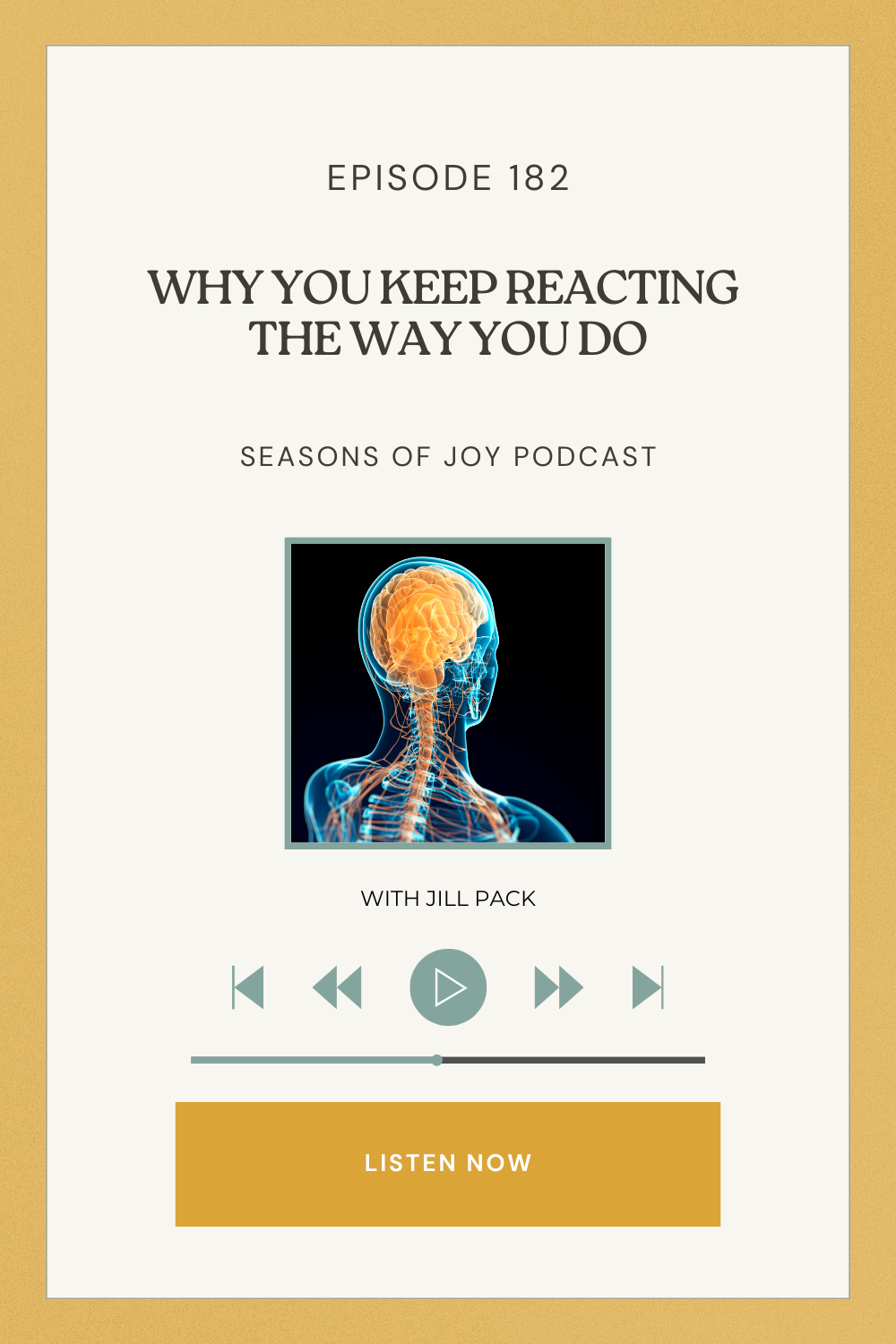
What's Really Happening in Your Brain When You Get Triggered
You have two parts of your brain running the show:
The Survival Brain (Your "Toddler Brain")
This part focuses on keeping you alive. It avoids pain, seeks pleasure, and conserves energy. This brain is fast, automatic—it doesn't think, it just reacts. All your patterned behaviors from the past are hardwired here.
When you're being chased by a tiger, this brain is perfect. No time to think, just run.
The problem? This brain doesn't know the difference between a tiger and your daughter telling you she's not coming home for Christmas. Both register as danger.
The CEO Brain (Your Prefrontal Cortex)
This is where you think critically, plan ahead, regulate emotions, and make good decisions. This is the part of your brain you want making decisions about your relationships.
Here's the critical problem: When your survival brain perceives threat, it shuts down access to your CEO brain. You literally cannot think clearly when you're activated. You can't access logic. You can't regulate your emotions the same way.
This is why you say things you regret. This is why all those great communication strategies you've learned fly out the window in the moment. Your CEO brain has gone offline, and your survival brain has taken over.
It's not because you're weak or not trying hard enough. It's just how your brain works.
The Physical Signs of Being Triggered
When you get triggered, your body experiences:
Increased heart rate and blood pressure
Rapid, shallow breathing
Muscle tension
Sweating
Shut down digestion (your body thinks, "We don't have time to digest food—we need to run!")
Dramatically reduced access to clear thinking
This is your stress response mobilizing for action—fight or flight. We need this response when there's actual danger. It's life-saving.
But most of the time, we're not in actual danger. Your son's eye roll is not a threat to your survival. Your mother-in-law's comment at Thanksgiving is not going to kill you. Your body doesn't know the difference, though.The Three Nervous System States (And Why You Need to Know Them)
Strategized clear structure for scannable podcast-to-blog conversion.
This is a crucial section. I want to make sure I present the three states clearly with good headers and make it very scannable. These are the main takeaways of the episode.
Understanding these three states will transform how you see yourself and your relationships.
State #1: Team Resilient (Ventral Vagal)
Leah calls this state Team Resilient. This is your social engagement system—where you're regulated, grounded, aligned, present, and centered.
In this state:
You can think clearly
You can connect with others
You have access to compassion and curiosity
Your breathing is easy
Your heart rate is steady
You can make eye contact
Your face is relaxed
This is where transformation happens. This is where you want to be for your important relationships.
What this looks like: You're out with your daughter and she tells you she's decided to stop going to church. You feel that squeeze in your chest (of course you do), but you can stay present. You can take a breath and say, "Tell me more about that." You're sad about her choice, but you're not making it mean you failed. You can hold space for your feelings and still stay connected to your daughter.
State #2: Team Hyper (Sympathetic State)
Leah calls this state Team Hyper. This is your mobilization state—fight or flight. Your body perceives danger and mobilizes you to take action.
In this state:
Your heart rate increases
You get a flood of stress hormones
Your muscles tense
You feel activated, agitated, anxious, or angry
You're defensive with lots of energy
You've lost access to clear thinking
You can't access compassion the same way
What this looks like: You get a text from your son about something he's frustrated about, and before even fully reading it, you're firing back a defensive response. Your heart is racing. You can hear your voice getting louder in your head as you type. Or it's you lying in bed at 2:00 AM replaying a conversation from dinner, thinking of all the things you should have said, all the ways you could have defended yourself better. You're activated, mobilized, and you can't access your clear thinking.
State #3: Team Hypo (Dorsal Vagal)
Leah call this state Team Hypo. This is your immobilization state—shut down and collapse. When fight or flight doesn't work, when the danger feels like too much, your system's last resort is to shut down completely.
In this state:
Your heart rate actually decreases
You feel numb, checked out
You might feel like you're watching your life from far away
You experience hopelessness, helplessness, exhaustion
You have no access to connection
You don't even have the energy to fight anymore
What this looks like: After months or years of conflict with your adult child, you just don't have it in you anymore. You stop reaching out. You stop trying. You go through the motions at family gatherings, but you're not really there. You're just numb, checked out, surviving.
The Biology of Your Responses
Here's what's crucial to understand: You move through these states in order, and it's not a choice. It's biology.
These are automatic responses. When you're in a regulated state (Team Resilient) and something happens that feels threatening, your body doesn't ask permission to move into Team Hyper. It just does it.
If your system still perceives threat, it moves into fight or flight. And if that doesn't work—if you still don't feel safe—it moves into shutdown.
There are no bad states. We actually need all three. They're all trying to protect us. The problem is when you get stuck—when you're living in chronic anxiety (Team Hyper) or chronic shutdown (Team Hypo). The goal is to be able to move through these states fluidly and come back to home base (that regulated state) when the threat is over.
This Changes Everything
When we understand that our reactions aren't character flaws but nervous system responses, it makes a profound difference.
You can stop beating yourself up for not being able to "just stay calm." You can stop thinking there's something wrong with you because you can't seem to handle conflict the way other people do.
Instead, you can realize: "Oh, my nervous system is doing exactly what it was trained to do based on my past experiences. And now that I understand that, I can start to work with it instead of against it."
Here's the truth: You can't think your way out of a nervous system response. You can't just choose to stay regulated when your body is screaming "danger."
But you can:
Learn to recognize what state you're in
Learn tools to help you shift states
Build your capacity over time
Your Practice This Week: Just Notice
I know this is a lot of information. Your brain might feel a little full right now, and that's completely normal.
Here's my invitation for this week: Just start noticing.
Notice when you feel regulated—when you're in Team Resilient. What does that feel like in your body?
Notice when you get activated—when you move into Team Hyper. What happens in your body? What sent you there?
Notice if you shut down—if you move into Team Hypo. What does that feel like?
Just notice. No judgment. Not trying to fix it. Just awareness.
Because awareness is always, always the first step.
What's Next
In my next post, we'll talk about how to build safety, which is the foundation for everything else. We'll explore creating your safety anchor and the fundamentals that support your nervous system.
But for now, just practice noticing. Pay attention to your body and start recognizing when you're in these different states.
Ready to go deeper? If you're finding this helpful and want personalized support navigating difficult relationships with your adult children, that's exactly what I help midlife women do in my coaching practice. Understanding your nervous system is just the beginning—together we can build the skills and resilience you need to move from friction to connection.
Remember: Your nervous system is not your enemy. It's just trying to protect you.
Want More Clarity?
Are you ready to take it to a deeper level? Jill would love to be your coach!
Visit seasons-coaching.com to learn more about working with me, or connect with me on Instagram @seasons_coaching.
Click HERE to learn about all the ways you can work together!
Click HERE to schedule a FREE Clarity Conversation with Jill.
Click HERE to check out her FREEBIES!
To contact Jill about speaking to your group or business, email her at jill@seasons-coaching.com.
Don’t forget to subscribe to the podcast and rate and leave a review! Help spread these tools!
About the Host: Jill Pack is a certified faith-based life + relationship coach and member of the Church of Jesus Christ of Latter-day Saints. She helps women of faith navigate their seasons of life with greater purpose and joy including how to transform conflict into connection. For more resources or to work with Jill, visit www.seasons-coaching.com.
Keywords for SEO: why do I overreact in conversations, can't stay calm with adult children, midlife women and family conflict, conflict with adult children, conflict resolution, conflict transformation, self-regulation